Cymbals Don't Catch Trains: A Field Manual for the Post-Gig Scramble
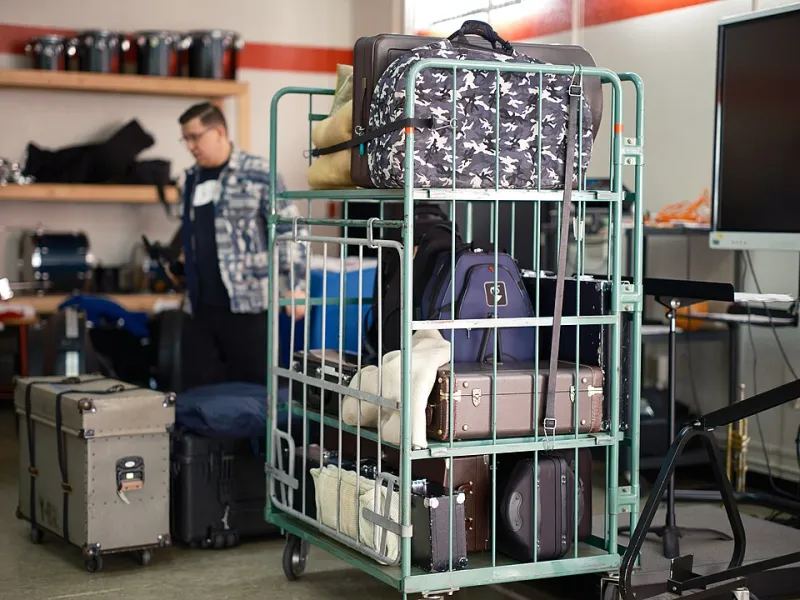
Photo: U.S. Navy CFA-Y by James Kimber, Public domain, via Wikimedia Commons
The final chord rings out, the crowd roars, and somewhere a landlord starts stacking chairs with the enthusiasm of a man who has seen too many encores. Most bands think the gig ends here. It doesn't. The gig ends when the last cymbal is in its case, the merch tin is accounted for, and every member of the band is physically inside a building they actually live in. Until then, you're still on the clock — and the clock is a lot less forgiving than the audience.
The clock starts at soundcheck, not at last orders
Here's the thing about last trains: they don't care that you nailed the solo in 'Fag Ash and Feedback'. They leave at 23:47 whether you've found your pedalboard power supply or not. So the first rule of the exit is to treat the timetable as part of the setlist.
Before you play a note, somebody needs to become the Clock Marshal. This is not a glamorous role. It involves squinting at a phone, saying "right, last train back to Crewe is 23:14, so we need to be loaded by ten past" and then repeating it every twenty minutes until people believe you. Put the times in the band group chat. Screenshot them. Pin them. Make it impossible to claim ignorance at 23:30 when someone is still at the bar explaining the difference between a reverb and a delay to a stranger in a flat cap.
Work backwards. If the last train is 23:47 and the station is a twelve-minute walk with a guitar case, you need to be out of the venue by 23:20 at the absolute latest. That means the encore finishes at 22:55, which means you need a word with the promoter about stage times before the doors even open.
The load-out liturgy
Packing a band's worth of gear is not a random act. It's a liturgy, and like all liturgies it should be performed in the same order every time, by people who know their part.
The correct order, as any road dog will tell you, is: valuables first, then breakables, then heavies. The merch tin and the cash box go straight into the van or the designated responsible adult's backpack before anyone has a chance to 'just put it down for a second'. Guitars and basses go in cases and into the van next, because they're the most nickable and the most mourned if lost. Then amps and pedalboards, then drum hardware, then shells, then cymbals. Cymbals last because cymbals are the thing everyone forgets. Every single time. There's a reason drummers develop a thousand-yard stare.
Label your cases. Not with a tasteful monogram — with gaffer tape and a fat marker pen. 'FREDDIE — DRUM HARDWARE — DO NOT PUT BEER ON THIS' is not a design statement, it's a survival strategy. When three bands share a back room, the mystery black case with no name on it becomes everybody's problem and nobody's responsibility.
The drummer containment protocol
No guide to the post-gig exit would be complete without addressing the drummer, who has — through no fault of their own — been sitting down all night and is now determined to make up for it by having a pint, a chat and possibly a kebab.
The drummer wrangler is a real role and should be assigned before the set. Their job is simple: keep the drummer in the vicinity of the van. Not by force. By diplomacy. By gently reminding them that the last train doesn't have a drum riser, and that the pint will still be a pint if it's drunk standing next to a Ford Transit.
Introduce the pint amnesty. Any drink purchased in the final twenty minutes can be finished at the van, on the pavement, in the rain, while someone works out how to fit a kick drum around a spare tyre. It's not dignified, but it's efficient. The alternative is a forty-minute search of the venue that ends with the drummer in the smoking area telling a stranger about the time he supported a band you've never heard of in 2019.
The minicab maths
Splitting a cab is where friendships go to die. The surge price is up, the app is asking for confirmation, and the one person who said 'I'll sort it' is now asleep against a lamp post.
The rule is simple: whoever books, pays. Screenshot the receipt. Put it in the group chat before the car has pulled away from the kerb. Settle it within twenty-four hours, ideally while everyone still remembers being in a good mood. Cash is fine, bank transfer is fine, but 'I'll get you back next time' is how bands end up with a ledger of resentment that outlasts the setlist.
If you're splitting a minicab with the support act, agree the split before you get in. Nobody wants to be the person arguing about £6 at 1am while the driver silently updates his opinion of musicians. And if someone's journey is significantly shorter, be a grown-up about it. The karma will come back to you when your amp blows a valve in Whitstable.
Van Tetris and the mystery cable
Loading a van is a skill, and like all skills it improves with practice and shouting. Heavy stuff over the axle. Nothing loose that can become a projectile when you brake for a fox on the A12. The person who isn't carrying anything becomes the Load Director, standing in the road with a torch and a look of enormous authority.
There is always one cable that belongs to nobody. It lives in the van, it comes out at every gig, and it will one day be the only thing left in the world after the apocalypse. Keep a van kit: gaffer tape, a torch, hi-vis vests, a spare phone charger and a bin bag for the inevitable spillage. Future you will be grateful, even if present you wants to go home.
The roll call
Before the van doors close, do the roll call. Humans, instruments, merch tin, keys, phones, the setlist (for the archive, not the bin), and the venue's pint glass — which goes back on the bar, not in the backline case. Take a photo of the loaded van. Send it to the group chat. If something's missing, you'll at least know it was missing before you got to the motorway.
The 23:47 dilemma
Sometimes the van isn't an option. Maybe the drummer's got work at eight, maybe the parking is a nightmare, maybe the promoter's cousin has borrowed the van. If you're splitting the exodus — some in the van, some on the train — decide early and stick to it. Leave the backline in the venue's cellar with a written note and a photo of the landlord's permission. Don't leave it in a doorway with a traffic cone on top and call it security.
The gig isn't over when the applause stops. It's over when everyone's home, the gear is accounted for, and the group chat has a photo of a van that is actually parked outside someone's house. Treat the exit as part of the show, and the last train becomes a supporting act rather than the headline.